


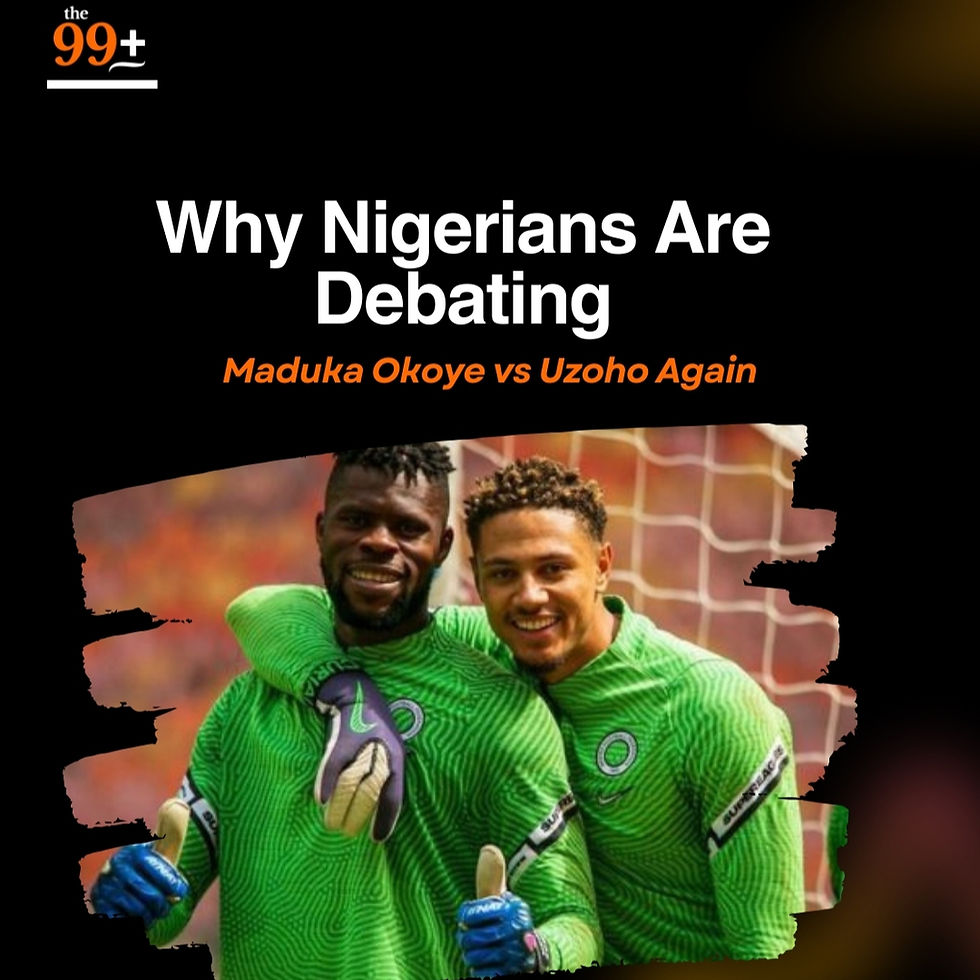
Why Nigerians Are Debating Maduka Okoye vs Uzoho Again

The Super Eagles goalkeeper debate has a habit of returning exactly when pressure rises. A major match approaches, squad lists are imminent, and timelines split once more: Maduka Okoye or Francis Uzoho? It’s not a new argument. But it’s louder again — and this time, it’s less emotional than it used to be.
This isn’t gossip. It’s a familiar Nigerian football pattern reloading.
Every time the Super Eagles prepare for a defining fixture, conversations drift away from tactics and midfield balance toward one question: who do you trust in goal? That question refuses to disappear because goalkeeping sits at the intersection of confidence and consequence. One decision can steady a team. One error can unravel it.
“As pressure builds, the Maduka Okoye vs Uzoho debate returns — not as noise, but as a serious question of trust.”
This Isn’t the First Time Nigeria Has Been Here
Nigeria has seen this movie before.
From Vincent Enyeama and Austin Ejide debates in the early 2000s, to late-stage arguments over Enyeama’s eventual successors after 2014, the Super Eagles have repeatedly struggled with goalkeeper succession moments. Each cycle follows a similar pattern: a long-serving option holds the jersey through experience, a challenger emerges with form, and fans push for change when results feel fragile.
The Okoye–Uzoho conversation fits neatly into that lineage. It isn’t a sudden crisis. It’s a recurring checkpoint Nigerian football hits whenever continuity and performance stop aligning perfectly.
Why the Maduka Okoye vs Uzoho Debate Keeps Resurfacing
How We Got Here (Again)
Francis Uzoho’s advantage has always been continuity. He has accumulated caps, tournament exposure, and coaching trust. Since his breakout during the 2018 World Cup qualifiers, he has remained the default choice across multiple coaches, often starting by virtue of familiarity rather than competition.
That history matters. But history alone does not insulate a goalkeeper.
Over the last two years, Uzoho’s performances — for club and country — have generated mixed reactions. Not because of a collapse in ability, but because the margin for error has narrowed. Modern international football increasingly demands more from goalkeepers: clean decision-making under pressure, comfort in distribution, command during transitions.
When those elements feel inconsistent, even briefly, the conversation reopens.
That’s the opening Maduka Okoye has stepped into.
Maduka Okoye and the Question of “Current Form”
Okoye’s case rests almost entirely on timing.
His AFCON 2021 struggles remain part of public memory. They are real, and they explain why his name still triggers caution. But they are also dated. Since then, Okoye has played regularly at club level, rebuilt confidence, and refined aspects of his game that previously felt rushed — particularly composure and shot-stopping rhythm.
What has shifted is not hype, but visibility. Nigerian fans are no longer judging him solely on national-team snapshots. They are watching weekly performances, observing calmer decision-making and sharper recovery.
That observation fuels interpretation: if form is current, why shouldn’t selection be?
Why This Debate Only Escalates Before Big Matches
This argument does not dominate during friendlies or low-stakes windows. It spikes when qualification margins tighten.
Before qualifiers.
Before tournaments.
Before matches that feel emotionally loaded.
The reason is simple: goalkeeper errors carry disproportionate weight. A missed chance is forgivable. A defensive lapse can be absorbed. A goalkeeping mistake often defines narratives.
Recent Uzoho outings have not been catastrophic. But they have produced moments of hesitation — rushed clearances, delayed reactions, uncertainty under pressure. Observationally, fans hold their breath more often. Interpreting that reaction, trust begins to erode.
Once that happens, familiarity becomes a liability rather than reassurance.
Form vs Familiarity: The Actual Decision Point
This debate is not philosophical. It is practical.
Uzoho offers continuity: understanding of defensive partnerships, experience in high-pressure tournaments, institutional trust from coaches.
Okoye offers momentum: match sharpness, consistent club minutes, and a sense of upward trajectory.
Nigerian fans are increasingly prioritizing the latter. Not out of sentiment, but out of risk assessment. In a period where qualification margins are thin, supporters want the goalkeeper who looks most settled now, not the one who has survived pressure before.
That shift explains the tone change in this debate. It’s less emotional, more evaluative.
What Coaches Are Quietly Assessing
Away from public sentiment, selection hinges on narrower criteria:
Communication with the backline
Comfort receiving and releasing under pressure
Command of aerial situations
Mental recovery after mistakes
These are not visible in highlight clips, but they determine selection longevity.
Coaches do not respond to online pressure. They respond to reliability. The problem is that reliability, once questioned, becomes harder to defend.
Why This Moment Matters Beyond One Match
This debate signals something larger than a single selection call.
Nigeria is approaching another transition point. Not just in goal, but in how performance is prioritized over tenure. If Okoye starts and performs well, it suggests a recalibration toward form-based selection. If Uzoho retains the jersey and steadies himself, it reinforces continuity as a stabilizing principle.
Either outcome shapes expectations for the next cycle.
What matters is not who starts the next match — it’s whether the Super Eagles finally settle a position that has lived in uncertainty since Enyeama’s exit. Until that certainty arrives, this debate will return before every major fixture.
And when it does, it won’t be noise. It will be a reflection of how much Nigerians understand what’s at stake.


Maduka Okoye all the way