


Why ‘Lagosian’ Is Becoming a Cultural Identity — Not Just a Location

At some point, “Lagosian” stopped meaning where you live and started meaning how you live.
It’s no longer a pin on a map.
It’s a tempo.
A posture.
A way of responding to pressure.
Ask ten people what makes someone a Lagosian and you won’t get geography—you’ll get attitude.
The debate keeps resurfacing online: Are you Lagosian if you weren’t born here? If you don’t speak the language? If you can’t navigate the chaos? And the argument always exposes the same truth: Lagos has evolved beyond place. It now manufactures a social code.
This is not accidental. Lagos doesn’t just host people; it reshapes them.
“Ask ten people what makes someone a Lagosian and you won’t get geography—you’ll get attitude.”
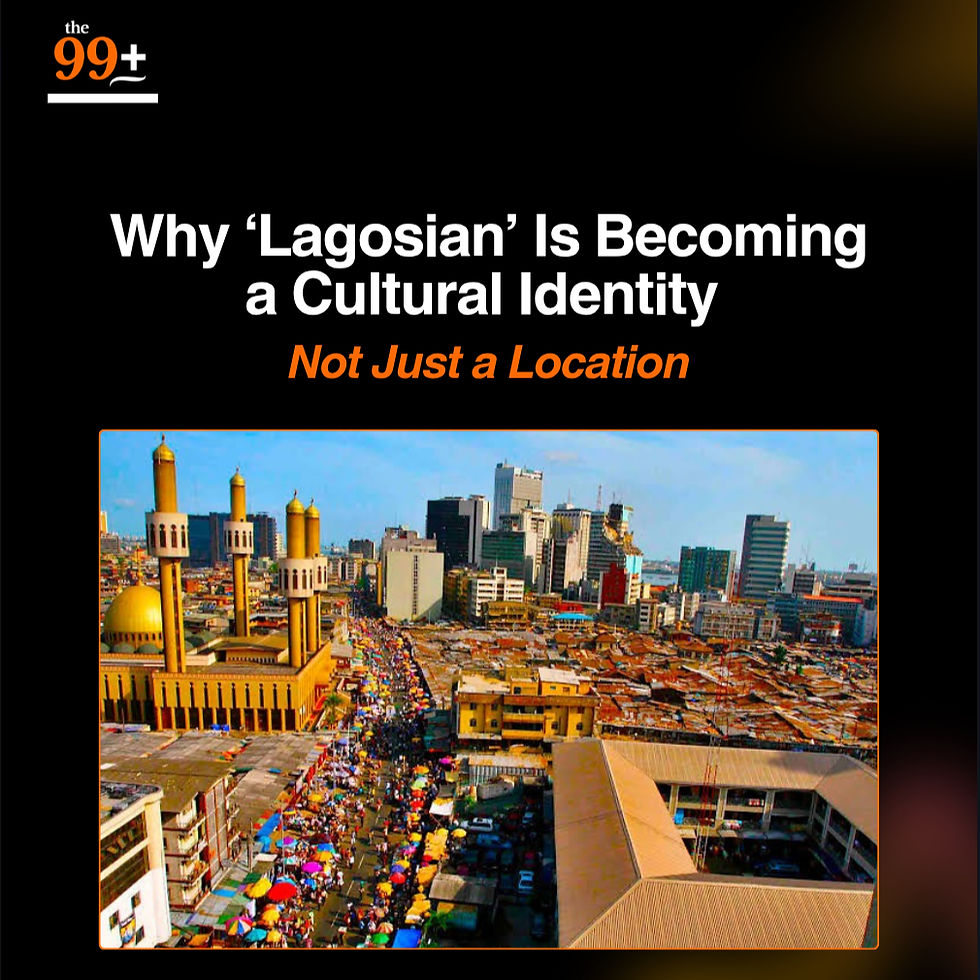
Lagos Produces a Way of Moving, Not Just a Population
Living in Lagos trains you. Daily. Relentlessly.
You learn speed—not because you want to, but because slowness costs money, time, and sometimes dignity. You learn alertness because distraction is expensive. You learn negotiation because systems rarely work cleanly, and survival often sits in the grey area between rules and reality.
A Lagosian understands urgency.
Knows when to push.
Knows when to bend.
Knows when to disappear and reappear stronger.
It’s not charm; it’s conditioning.
This is why two people can live in the same city and only one becomes “Lagosian.” One adapts. The other endures. Lagos rewards the former.
What It Really Means to Be a Lagosian Today: From Residence to Reputation
To be called Lagosian now signals something specific: toughness. Sharpness. Emotional armor.
It implies you can handle pressure without ceremony.
That you can take rejection, reroute, and keep moving.
That you understand how to read rooms, streets, power dynamics, and people who don’t say what they mean.
Outside Lagos, the word travels differently. It becomes shorthand. Employers say it. Creatives perform it. Cities mimic it.
“Lagosian” has become a reputation export.
The Export of Lagos Energy
You see it in Abuja, Port Harcourt, Accra, London, Toronto. Lagosian behavior travels faster than Lagosians themselves.
The hustle cadence.
The assertiveness.
The impatience with inefficiency.
The loud confidence masking quiet calculation. Lagos teaches people how to occupy space aggressively—even when they don’t own it yet.
In diaspora spaces, Lagosians are often described as “intense,” “driven,” or “too much.” But what looks like excess elsewhere is survival training here.
Lagos prepares you for global friction.
But Every Identity Has a Cost
The Lagosian identity isn’t just resilience—it’s also exhaustion.
Behind the celebrated toughness is burnout.
Behind the adaptability is constant anxiety.
The city teaches you to normalize pressure, even when it’s crushing.
To laugh through stress.
To keep moving because stopping feels dangerous.
And not everyone gets to wear the identity equally.
The Lagosian myth hides inequality. It flattens differences between those with access and those without. It glorifies struggle without questioning why the struggle is permanent. It celebrates aggression while ignoring how it excludes the soft, the slow, the disabled, the poor.
Not everyone thrives in Lagos—but everyone is expected to perform strength.
What “Lagosian” Really Means Now
To be Lagosian today is to have been shaped by contradiction.
Opportunity and violence.
Community and isolation.
Creativity and collapse.
It is to know how to survive systems that don’t care if you survive them.
It is no longer about birthplace. It is about fluency—social, emotional, economic.
And as long as Lagos remains a city that compresses millions into constant negotiation, the Lagosian identity will keep spreading. Not because people want it—but because once you learn it, it never leaves you.
You don’t just live in Lagos.
Lagos lives in you.


Comments