


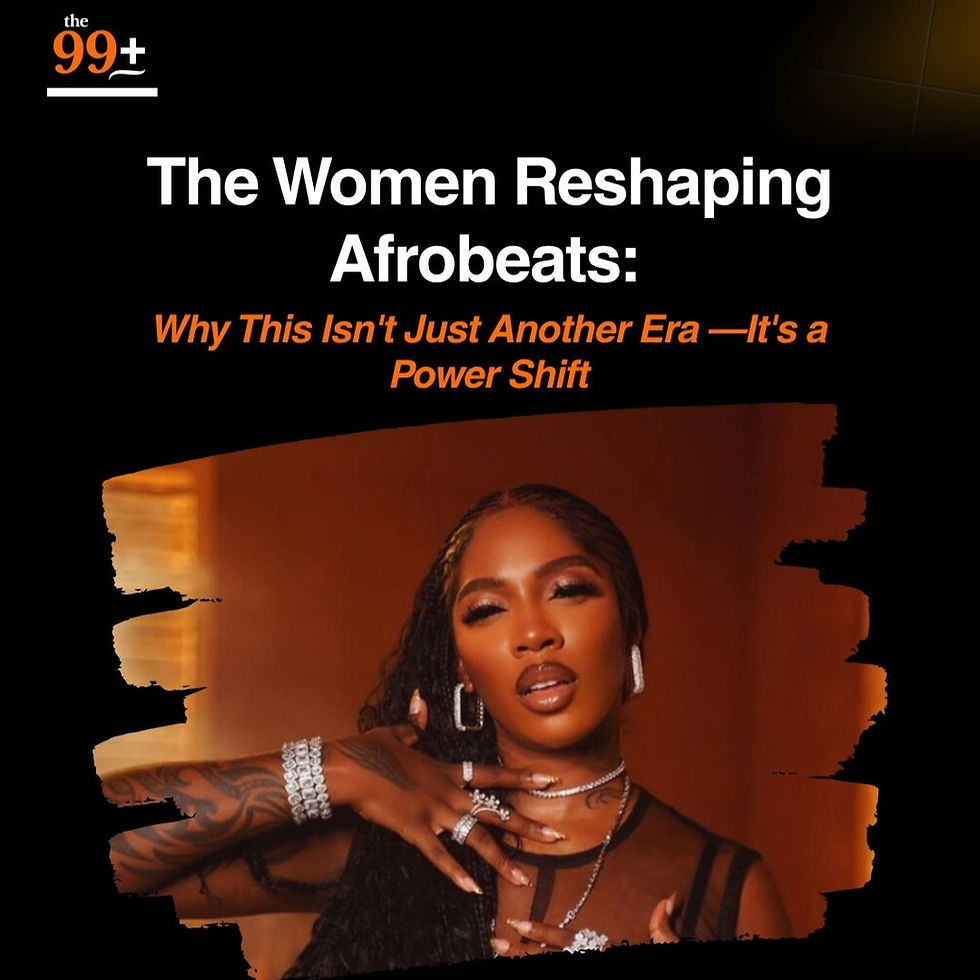
The Women Reshaping Afrobeats: Why This Isn't Just Another Era—It's a Power Shift

For years, Afrobeats has been sold to the world through a familiar script:
the breakout male star,
the viral anthem,
the cross-border hit,
the global co-sign.
That script was never the whole story, but it was the one that got repeated often enough to sound like fact.
Now that story is breaking apart.
Because one of the most important developments is the rise of the women reshaping Afrobeats—not just by winning inside the genre, but by influencing what it sounds like, how it travels, who gets taken seriously, and what the next phase of the culture looks like. It is that women are increasingly helping define what the genre sounds like, how it travels, who gets taken seriously, and what the next phase of the culture looks like.
That is not a side note.
That is a power shift.
The old conversation still lingers in the background. Every award season, every chart update, every new international moment seems to drag the industry back to the same tired question: who is the biggest female artist in Afrobeats? It is a question that sounds important, but often misses the point. It treats women like a category to be measured against a male default, rather than as central forces shaping the movement itself.
That framing no longer works.
Afrobeats is not simply making room for women. Women are already making Afrobeats bigger, wider, more exportable, more emotionally layered, and more difficult to define in the narrow terms the industry once preferred.
The end of the exception
There was a time when a woman breaking through in Afrobeats was treated like a special event.
One artist would rise.
One song would cut through.
One name would cross over.
And the industry would respond as though it had witnessed proof that women could succeed in the space, as if success itself was the surprise.
Then the system would reset.
That is the part that has changed.
Today, women are not arriving one at a time to be congratulated for surviving a male-dominated landscape.
They are showing up in clusters, across lanes, across markets, across moods.
They are charting.
They are touring.
They are headlining.
They are shaping collaborations.
They are moving culture.
They are becoming reference points for what Afrobeats can mean outside the continent as much as inside it.
That is what makes this moment different.
The exception has stopped looking like an exception.
Different women, different sounds, one expanding genre
The easiest mistake to make when discussing women in Afrobeats is to flatten them into one story. That approach is lazy, and worse, it misses the real significance of what is happening.
The point is not that Tems, Ayra Starr, Tyla, MOLIY, Yemi Alade, and Teni sound the same.
They do not.
The point is that they do not need to.
Tems has helped stretch the emotional and atmospheric range of the genre. Her music carries weight, tension, restraint, and depth in a way that forces a different kind of listening. She does not just fit into the soundscape; she alters its temperature.
Ayra Starr brings a different kind of energy altogether. Her appeal sits at the intersection of youth, confidence, vulnerability, style, and pop instinct. She is not simply a young female star. She is one of the clearest examples of how Afrobeats can remain culturally current without becoming creatively shallow.
Tyla, though often discussed through the lens of cross-market success, represents something else too: the ability of African-rooted music to travel globally without losing its own rhythmic identity. Her rise matters because it shows how African sounds can move into the mainstream conversation without being diluted into something generic.
MOLIY has carved out a lane through fluidity. She sits comfortably between worlds, which is part of the point. Artists like her make it harder to box Afrobeats into one fixed identity. That kind of movement is important because genres only stay alive when they keep stretching.
Yemi Alade remains one of the most underrated examples of durability in African pop. Longevity is not just about staying visible. It is about staying relevant while refusing to collapse into one market or one moment. Her career shows that African female artists can build careers that are both broad and sustained, without being reduced to a trend cycle.
Teni brings personality into the centre of the conversation. Her music carries humour, character, and a kind of narrative instinct that gives Afrobeats something deeper than just rhythm and replay value. She reminds the industry that memorability is not only about hooks; it is also about voice, presence, and point of view.
What matters most is not that these women are all successful in different ways. It is that their differences are helping Afrobeats become more expansive. The genre no longer sounds like one idea trying to dominate every room.
Afrobeats has expanded emotionally too
Another shift is happening beneath the surface, and it is easy to miss if the conversation stays locked on visibility and numbers.
Afrobeats has expanded emotionally.
The genre once leaned heavily on energy, movement, romance, and immediate pleasure. That remains central to its appeal. But in recent years, the mainstream has made more space for vulnerability, reflection, emotional tension, self-definition, and a wider sense of personal storytelling.
That did not happen by accident.
Women helped widen that emotional range by showing that Afrobeats could carry more than one mood at a time.
It could still be loud without being shallow.
It could still be danceable without being emotionally empty.
It could still be globally accessible without becoming emotionally neutral.
That matters because genres do not become global by repeating themselves forever. They become global by becoming readable across different emotions, contexts, and audiences. Women have played a major role in pushing Afrobeats toward that broader register.
And once a genre starts speaking in more emotional voices, it becomes harder to treat any one group as ornamental.
Global success is no longer following one blueprint
The international conversation around African music used to rely too heavily on the idea of a single pathway to success.
One style.
One type of artist.
One kind of record.
One shape of crossover.
That model is disappearing.
What is emerging instead is a more complicated, more interesting reality: there are many ways to become globally relevant from within Afrobeats.
Tems does not need to sound like Ayra Starr.
Tyla does not need to mirror Yemi Alade.
MOLIY does not need to fit into a single market formula.
That variety is not a weakness.
It is the proof that the genre is no longer dependent on one commercial template.
This is where women have become especially important. They are not just succeeding inside a fixed system. They are proving that the system itself can operate on multiple registers at once.
That changes the way the world sees Afrobeats.
It changes who gets playlisted.
It changes who gets booked.
It changes what international collaborators look for.
It changes how the genre is packaged for audiences that may not have come in through the usual door.
More importantly, it changes the value of originality.
A growing number of the most compelling female artists in Afrobeats are succeeding not because they are copies of a proven formula, but because they are the formulae themselves.
How Women Reshaping Afrobeats Are Changing the Industry Beyond the Charts: The business is changing too
This is where the conversation has to move beyond music criticism and into industry reality.
Because once women become impossible to ignore creatively, the business has no choice but to adjust.
Labels must rethink how they scout and develop talent.
Managers must rethink how artists are positioned across markets.
Publishers have to look harder at long-term catalogue value, not just short-term momentum.
Streaming teams have to understand that female-led narratives are not niche stories; they are central to how modern audiences engage with African music.
Brands have to stop treating women in Afrobeats as occasional campaign assets and start recognising them as core cultural drivers.
Festival organisers have to ask whether their line-ups actually reflect the genre they claim to represent.
These are not symbolic questions. They are structural ones.
For too long, the industry has asked whether female Afrobeats artists can sell. That question is already outdated. The better question is this: what happens to the business when women become some of the genre’s strongest commercial bets?
That is not a rhetorical question.
It affects budgets.
It affects strategy.
It affects visibility.
It affects investment.
And once those things shift, the industry can either adapt, or be left explaining why it was slow to recognise what was already in front of it.
This is bigger than gender
It is important not to shrink this conversation into a simplistic battle of men versus women. That is not the point, and it weakens the argument.
The point is that Afrobeats is stronger when creative power is spread across more voices. A genre becomes more resilient when it is not over-reliant on one kind of artist, one kind of story, or one kind of success pattern. More centres of influence do not dilute the genre. They deepen it.
That is what this moment is really about.
Women are not “joining” Afrobeats as an afterthought.
They are helping determine its direction.
They are expanding its emotional language.
They are influencing its global identity.
They are reshaping the assumptions around what commercial success can look like in African music.
That is not tokenism. That is authorship.
And once a genre reaches that point, the old language starts to sound small.
The real question
The industry still likes to ask who the biggest female artist in Afrobeats is.
It is the kind of question that sounds neat because it reduces a complicated cultural shift into a simple ranking. But rankings are often the refuge of people who do not want to confront transformation.
The more important question is this:
“What happens when women stop being exceptions and become architects?”
Afrobeats may already be living inside that answer.
The genre is becoming more global, more emotionally flexible, more commercially varied, and more culturally interesting. Women are not the only reason, but they are undeniably part of the reason.
That is why this is not just another era.
It is a power shift.
And the uncomfortable truth for anyone still treating it like a side conversation is that the future of Afrobeats may be shaped far more by women than the industry has been willing to admit.
The shift is not coming.
It is already here.


Wow insightful read