


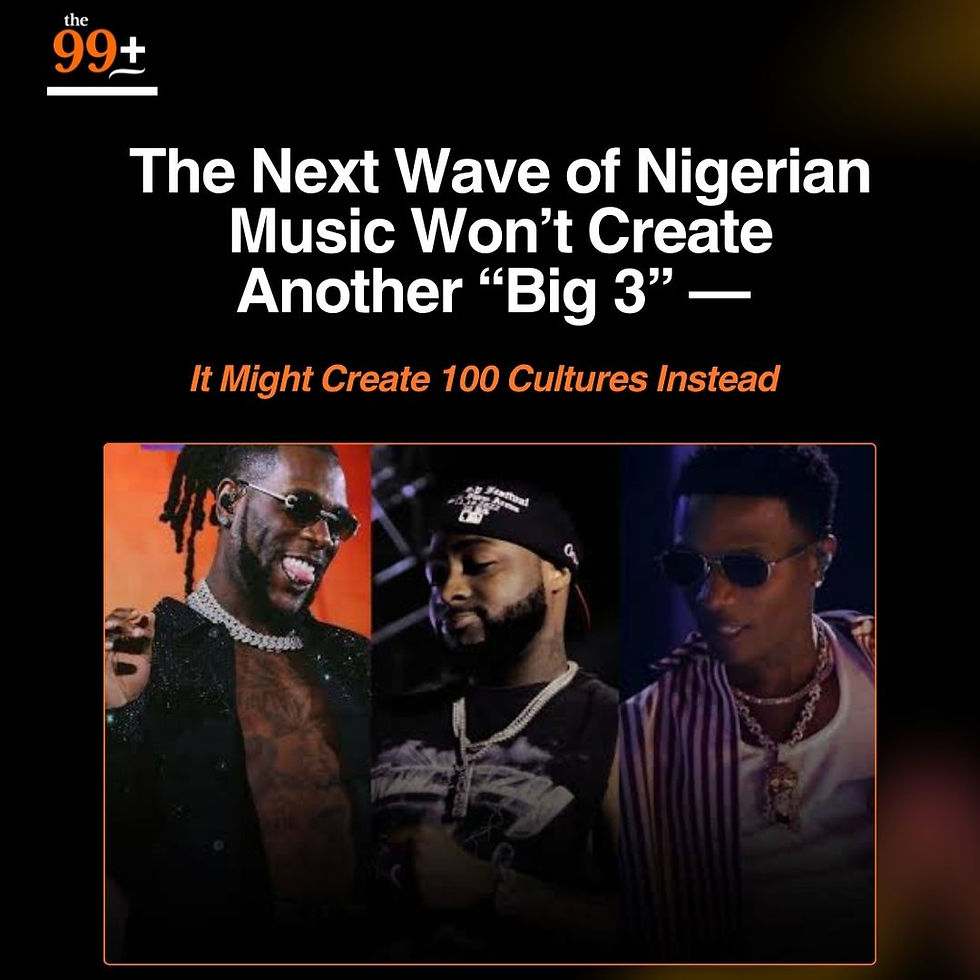
Nigeria’s Next Music Wave Won’t Create Another “Big 3” — It Might Create 100 Cultures Instead

For almost a decade, the Nigerian music conversation has been built around a familiar idea: who becomes the next global Afrobeats superstar?
The industry became conditioned to chase singular faces.
One artist dominates radio.
One sound defines the year.
One movement captures global attention long enough to become export-ready.
That model may already be collapsing.
The next era of Nigerian music is beginning to form quietly beneath the mainstream, but it does not look like the Wizkid–Davido–Burna blueprint that shaped the last generation. It is more fragmented, more internet-native, more visually driven, more experimental, and far less interested in waiting for industry validation.
And that may ultimately become its greatest advantage.
What we are witnessing now is the early shape of Nigeria’s next music wave — one driven less by industry structure and more by internet culture.
“The next era of Nigerian music may be harder to define — and that may be its greatest strength.”
What is happening now is not simply a “new wave” of artists. It is a structural shift in how Nigerian music itself is being discovered, consumed, marketed, and emotionally attached to.
The old system created superstars. The new internet may create movements instead.
The Superstar Pipeline Is Breaking Apart
The Nigerian music industry once had a relatively clear pathway to dominance.
Radio → blogs → club rotation → TV → nationwide familiarity → international crossover.
The formula was centralized enough that a few artists could realistically dominate the entire culture at once.
That ecosystem no longer exists in the same form.
TikTok shortened attention spans.
Streaming decentralized discovery.
Algorithms replaced gatekeepers.
Fan communities became smaller but more obsessive.
Artists stopped needing national approval before building meaningful careers.
Now, a record can explode online before radio even notices it.
An underground rapper can trend harder than a mainstream artist for two weeks without ever appearing on traditional charts.
Aesthetic identity can matter as much as the music itself.
And most importantly, audiences are no longer moving together.
That last point changes everything.
For years, Afrobeats functioned like a unified cultural wave.
Today, Nigerian music increasingly behaves like parallel internet subcultures happening simultaneously.
Street-pop audiences.
Alté communities.
TikTok-core listeners.
Rage rap fans.
Amapiano hybrids.
Afro-fusion minimalists.
Underground collectives.
Diaspora-focused sounds.
Fashion-led artist communities.
All existing at once.
All building their own ecosystems.
And none necessarily needing mass-market consensus to survive.
Why Nigeria’s Next Music Wave Is Built Around Communities, Not Superstars: Nigerian Music Is Becoming More Fragmented — But Also More Honest
One of the clearest signals of this shift is the growing visibility of underground and genre-fluid artists.
Publications like Culture Custodian, The Native, and discovery-focused platforms have increasingly shifted attention toward artists operating outside the traditional mainstream machine.
The underground is no longer behaving like a waiting room for mainstream success.
It is beginning to look like an alternative industry entirely.
Artists like Mavo, Zaylevelten, and others are gaining traction not because they sound universally commercial, but because they sound culturally specific to highly engaged internet communities.
That distinction matters.
Previous generations often had to smooth out their edges before crossing over.
This generation is monetizing the edges themselves.
The soundscape reflects that change too.
Hip-hop influence is returning aggressively.
Rage rap textures are creeping into Nigerian youth culture.
Street-hop keeps mutating.
Alté’s DNA has quietly infected mainstream aesthetics.
Fuji elements are being modernized again.
Dance music keeps blending with rap structures.
Even established artists are adapting.
Adekunle Gold’s recent Fuji-inspired experimentation on “Formation” alongside Olamide signals a broader return toward localized sonic identity rather than generic international polish.
The point is no longer sounding “global.”
The point is sounding distinct enough to build community.
TikTok Changed Artist Development Forever
The industry still talks about “artist development” as though labels fully control it.
They do not.
Not anymore.
TikTok, Reels, Discord communities, fan edits, meme culture, and algorithmic discovery have fundamentally altered how Nigerian artists emerge.
The internet now develops artists in public.
Shoday reportedly posted up to 60 TikTok videos daily before his breakout moment.
That statistic alone says everything about the new era.
Consistency.
Personality.
Visibility.
Relatability.
World-building.
These things now matter almost as much as songwriting itself.
The old generation often became stars first and personalities second.
This generation becomes emotionally familiar before becoming musically dominant.
Fans no longer just consume records.
They consume identities.
That is why visual storytelling, fashion language, humor, online behavior, and even meme literacy increasingly shape artist success.
The audience wants immersion now.
Not just music.
The “Next Afrobeats Superstar” Conversation May Already Be Outdated
There is still a tendency within Nigerian media to ask:
“Who is next?”
But maybe that question belongs to an older version of the industry.
The global rise of Afrobeats between 2020 and 2023 created the expectation that Nigerian music should continuously produce singular crossover giants.
But the conditions that enabled that explosion have changed.
Streaming audiences are more fragmented.
Trend cycles move faster.
Global attention is less concentrated.
Music discovery is increasingly algorithmic rather than cultural.
Even internationally, the monoculture era is fading.
Hip-hop itself is experiencing audience fragmentation in America.
Pop stars dominate less uniformly than before.
Internet micro-scenes now shape youth culture faster than traditional entertainment infrastructure.
Nigeria is not escaping this shift.
It is accelerating into it.
Which means the next generation may never produce one dominant “face” of the culture in the way previous eras did.
Instead, we may see:
Multiple medium-sized stars
Strong niche ecosystems
Faster artist turnover
More fluid genre identities
Communities replacing mass-market universality
And honestly?
That may be healthier creatively.
Nigerian Hip-Hop Is Quietly Reclaiming Space
One of the most interesting developments underneath the surface is the resurgence of rap influence within Nigerian youth culture.
Not necessarily traditional lyrical rap in the old sense.
But attitude-heavy, internet-shaped, experimental rap energy.
You can hear traces of Playboi Carti-inspired rage music.
Trap minimalism.
Alternative rap textures.
Aggressive underground aesthetics.
Street-hop fusion.
Dark internet production styles.
For years, mainstream Nigerian pop became heavily melody-driven and algorithmically optimized for broad streaming appeal.
Now younger artists increasingly sound less concerned with accessibility and more concerned with identity.
That shift is important because hip-hop historically thrives during moments of fragmentation.
Rap excels when subcultures matter more than consensus.
Which is exactly where Nigerian music appears to be heading.
Music Is No Longer Existing Alone
Another major shift is how artists are increasingly positioning themselves beyond music itself.
The modern Nigerian artist is becoming:
A visual identity
A fashion language
A lifestyle marker
A meme ecosystem
A short-form content engine
A cultural narrator
Music-to-film crossover momentum is accelerating.
Visual-first storytelling matters more.
Fan engagement is becoming more community-based than celebrity-based.
The audience no longer buys only into songs. They buy into worlds.
That is why artists with strong aesthetics often outperform artists with technically stronger music but weaker identity systems.
The internet rewards cohesion.
Not perfection.
Afrobeats Isn’t Dying — It’s Mutating
Recent conversations around Afrobeats “declining globally” miss an important nuance.
What may actually be happening is not decline, but decentralization.
The global peak era created unrealistic expectations of permanent upward momentum.
But genres evolve.
Scenes fragment.
Audiences diversify.
And cultures reinvent themselves.
Afrobeats was never supposed to remain frozen in its 2021 form forever.
The current instability may actually be the early stage of Nigeria’s most creatively unpredictable era yet.
Because once artists stop chasing a singular dominant formula, experimentation increases.
And experimentation usually creates the next real breakthrough.
“The next Nigerian stars are not waiting for the industry to discover them anymore.”
That may ultimately become the defining sentence of this entire era.
Chief Editor’s Note
I genuinely think the Nigerian music industry is entering one of its most misunderstood transitions in years.
A lot of people are still searching for the next Wizkid, Davido, or Burna Boy because that is the model the industry learned to understand.
But the internet does not build culture the same way anymore.
What I see forming now is less centralized, less predictable, and honestly more creatively dangerous.
Smaller communities.
Stronger identities.
Faster movements.
Artists building worlds instead of just songs.
The next generation may never dominate everybody at once — but they may own their corners of culture far more deeply than previous eras ever did.
And if that happens, Nigerian music will not become weaker.
It may actually become more powerful than before.
— Sean
Chief Editor, The 99Pluz


Comments